
AI process optimisation
We analyse how your company works using the data you already have, detect where orders, projects or incidents get stuck, and apply artificial intelligence only where it has a clear return.
It is the ideal starting point if you sense that AI could improve your operations but need to know where to begin. We work with SMEs in Tarragona, Catalonia and across Spain.
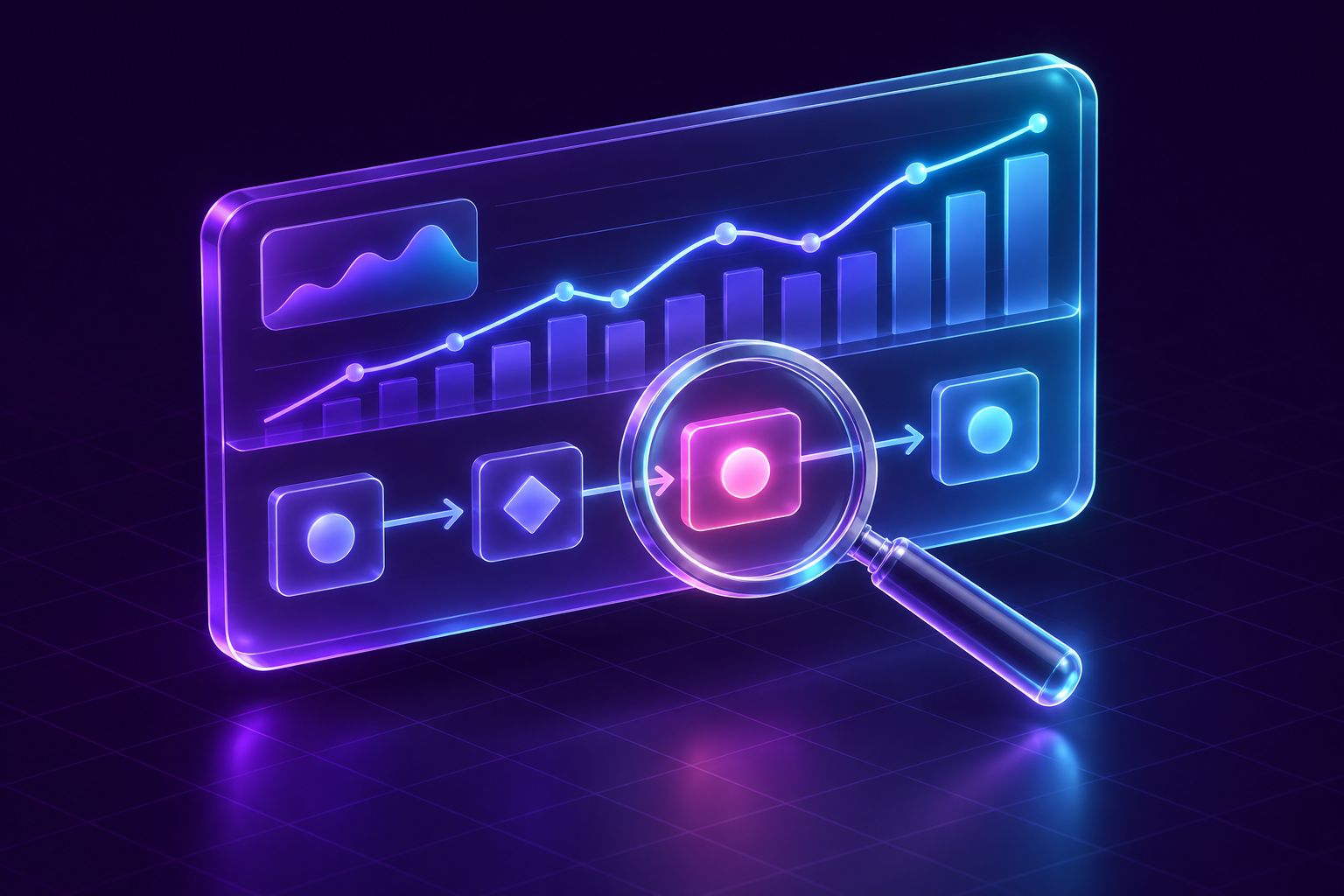
Know where time is lost before you invest
Buying AI tools without knowing which problem you want to solve is starting at the end. We start with the process.
The problem
You know something isn’t flowing: deadlines stretch, the team is overloaded and there are always tasks waiting on someone. But it isn’t clear exactly where the bottleneck is, what it costs or which solution makes sense. The data exists, scattered across the ERP, spreadsheets and emails, but nobody has time to analyse it.
- Delays whose origin is not known for certain
- Decisions made on intuition, not data
- Technology investments that don’t solve the real problem
- Indicators calculated late and by hand
What we achieve
We carry out a process analysis backed by your data: we measure times, waits and volumes, locate the bottlenecks and prioritise improvements by impact. Then we implement the AI solutions that make sense for your case and measure whether they work.
- A clear map of your processes and where they get stuck
- AI use cases prioritised by return and effort
- Dashboards with indicators you can check daily
- A phased implementation plan, with no blind bets
What AI process optimisation includes
From assessment to measurable improvement, step by step.
Process audit
We walk through your key processes with you, from start to finish, and document who does what, with which tools and where the waits appear.
Data quality review
We check which data you have, where it is and whether it is reliable enough to analyse or train models, and propose how to improve it.
Bottleneck detection
We analyse times, volumes and delays using your real data to locate the points that hold back the whole operation.
Use cases with a clear return
We identify where AI can genuinely help and compare it with simpler solutions. If AI isn’t needed, we tell you.
Models and dashboards
We develop analysis, classification or prediction models adapted to your operations, and panels with actionable indicators.
Phased plan and measurement
We implement the improvements in phases and measure the results with the same indicators to decide the next step.
How we work
A clear process with no surprises: you know what we are going to do, what it costs and who you are talking to.
Free first meeting
You tell us your idea or your problem and together we see whether it makes sense. No cost and no obligation.
Written scope document, reviewed together
Before giving you a price, we deliver a written scope document covering the scope, the phases and what is left out. We review it with you and then give you a fixed price broken down by phases.
You test every delivery
We work in deliveries that you test from the first weeks, and you talk directly to the team developing your project.
Your technology partner
After go-live we stay by your side: support, improvements and evolution whenever you need them.
AI process analysis: use cases by sector
Hypothetical examples of bottlenecks that can arise in a company and how AI could address them.
Logistics and transport
For example, a transport company could analyse its history of routes, loads and incidents to detect which stretches or time slots generate the most delays and adjust its planning.
Industry
For example, a production plant could cross-reference manufacturing orders, stoppages and maintenance to find the machine or step that limits the capacity of the whole line.
Support and services
For example, a technical support service could automatically classify its tickets, measure how long each type waits and detect at which stage they pile up.
Retail and distribution
For example, a distributor could use a demand forecasting model to anticipate stock-outs and adjust purchasing instead of reacting late.
Agri-food
For example, an agri-food company could analyse receiving, grading and dispatch times to balance shifts in high season.
Administration
For example, an administration department could measure the full cycle of an invoice, from arrival to payment, and locate at which approval it gets held up.
Data, models and dashboards built around you
We work with Python and its data analysis ecosystem, large language models (LLMs) to classify and understand text, prediction and classification models, and web dashboards connected to your sources. We extract information from your ERP, CRM, spreadsheets or databases via API or direct connections, always with access control. We choose the tools to suit your case, not the other way round.
Frequently asked questions about AI process optimisation
What is AI process optimisation?
It means analysing how your processes work with the help of your data and applying artificial intelligence to improve them: detecting delays, prioritising tasks, forecasting demand or classifying information automatically. The goal is faster operations with fewer errors.
How is a process analysis carried out?
We start with interviews with the people who work in the process and with the data from your systems. We map the real flow, measure times and waits at each step and compare what is actually done with what people think is done. The prioritised improvements come from there.
How are bottlenecks detected with data?
We analyse when each order, project or incident enters and leaves each stage. Where waiting time builds up or volume exceeds capacity, that is the bottleneck. AI helps to classify cases, detect patterns and warn before the backlog grows.
What data do I need to get started?
Usually the data you already generate is enough: ERP or CRM records, spreadsheets, tickets or emails. It doesn’t need to be perfect; part of the work is reviewing its quality and deciding what can be used.
What is the difference between optimising and automating processes?
Optimising is deciding what to change and in what order, based on analysis. Automating is making a specific task run on its own. The usual approach is to optimise first and then automate what has the greatest impact.
How much does an AI optimisation project cost?
It depends on the number of processes analysed, the amount and condition of the data, whether models or dashboards need to be developed and the support afterwards. After a free first meeting we deliver a written scope document with the scope and the phases, review it with you and give you a fixed price broken down by phases.
What if it turns out I don't need AI?
We will tell you. Sometimes the bottleneck is solved with a process change, an integration or a data dashboard. We only propose what makes sense for your case.
Related services
AI automation
Automate the repetitive tasks the analysis identifies as priorities.
AI assistant with your documents
Answers based on your company’s manuals, contracts and procedures.
Web applications and back office
Dashboards and internal panels with your indicators up to date.
Further reading (in Spanish): An AI assistant with your company’s documents: how it works and what you need and Custom software vs. standard software: when it pays off for an SME. You can also see all our services.
Where does your company get stuck?
Tell us in a short call. We’ll help you find the bottleneck and decide whether AI is the best way to solve it.